
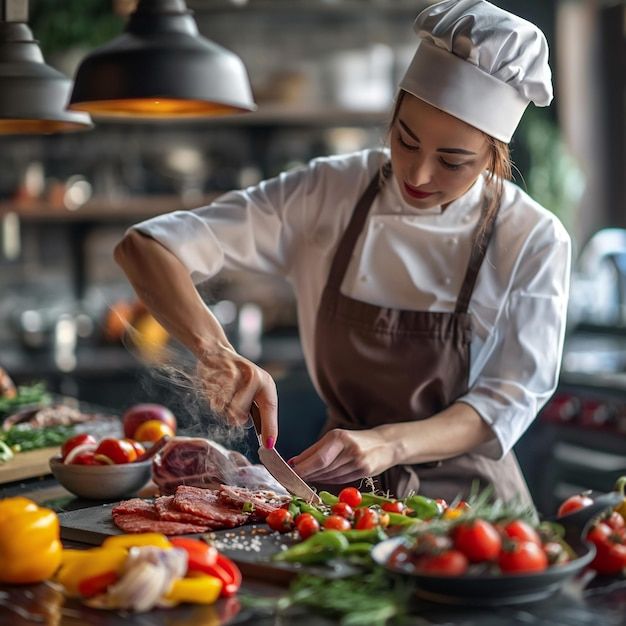
One of the most basic skills in the kitchen is how to properly use a knife. If you’re cutting vegetables, chopping herbs, or filleting fish, Essential Knife Skills for Culinary Students. For aspiring chefs, keeping these knife skills down pat is important not just for being efficient but also for creating perfectly crafted dishes
Before you can learn the finer points of knife work, you need to know how to hold your knife. The “pinch grip” is the normal method, where you pinch the blade between your thumb and index finger and wrap the other fingers around the handle. This grip provides more control and precision.
When cutting with a chef’s knife, it is important to employ the rocking motion for even, smooth cuts. The blade will rock in a soft arc, from tip to heel, while the other hand directs the food being cut. Knife Skills Every Culinary Student Should Know. This method produces consistent cuts and enables efficiency when chopping vegetables or herbs.
The julienne cut is a technique that creates long, thin strips of food, often used for vegetables like carrots, zucchini, and peppers. This technique is important because it allows for even cooking and ensures uniform presentation. Learning to julienne with precision is an essential skill for any culinary arts diploma for hotel management students.
When you’re asked for diced or chopped ingredients in a recipe, cutting with a sharp knife and a correct technique is most important. Dicing refers to cutting food into equal-sized cubes, and chopping is not quite as accurate a cut. Having the skill to prepare immaculately diced vegetables for a salad or soup will have you working faster and presenting your meals with a professional touch.
Mincing is cutting ingredients thinly, normally herbs, garlic, or onions. Practice mincing carefully and consistently since it can affect the flavor and texture of your cuisine. The more finely the mince is cut, the more the flavors will be well-mixed in food.
Practice filleting fish or de-boning poultry is an excellent advanced knife technique that will make you stand out from other culinary students. It takes a lot of skill, however, because if you cut incorrectly, you’ll waste product or create conditions for unsafe handling. If you’re enrolling in an international culinary course in hotel management, you will want to master these skills so that your method conforms to global culinary standards.
A sharp knife is a safe knife. Knowing how to sharpen and maintain your knives properly will not only enhance your accuracy but will also maximize the life of your equipment. Honing regularly and periodic professional sharpening are basic practices in a professional kitchen.
Slicing is a critical skill for making perfectly consistent pieces of food, whether slicing tomatoes for a salad or cutting meat for a steak. A steady hand and sharp knife are most important in getting those thin, consistent slices.
Mastering Essential Knife Skills for Culinary Students is just the beginning of your culinary journey. With the right culinary arts training in hotel management, you’ll be ready to take your career to new heights. Our programs, including the culinary arts diploma for hotel management students and the international culinary course in hotel management, offer expert instruction in all aspects of culinary techniques, including food and beverage management with a culinary focus.
To know more about culinary arts, talk to our expert on the best Hotel management course, I AMT Global Academy. 088931 00700






 contact@iamtglobal.com
 +918893100700